
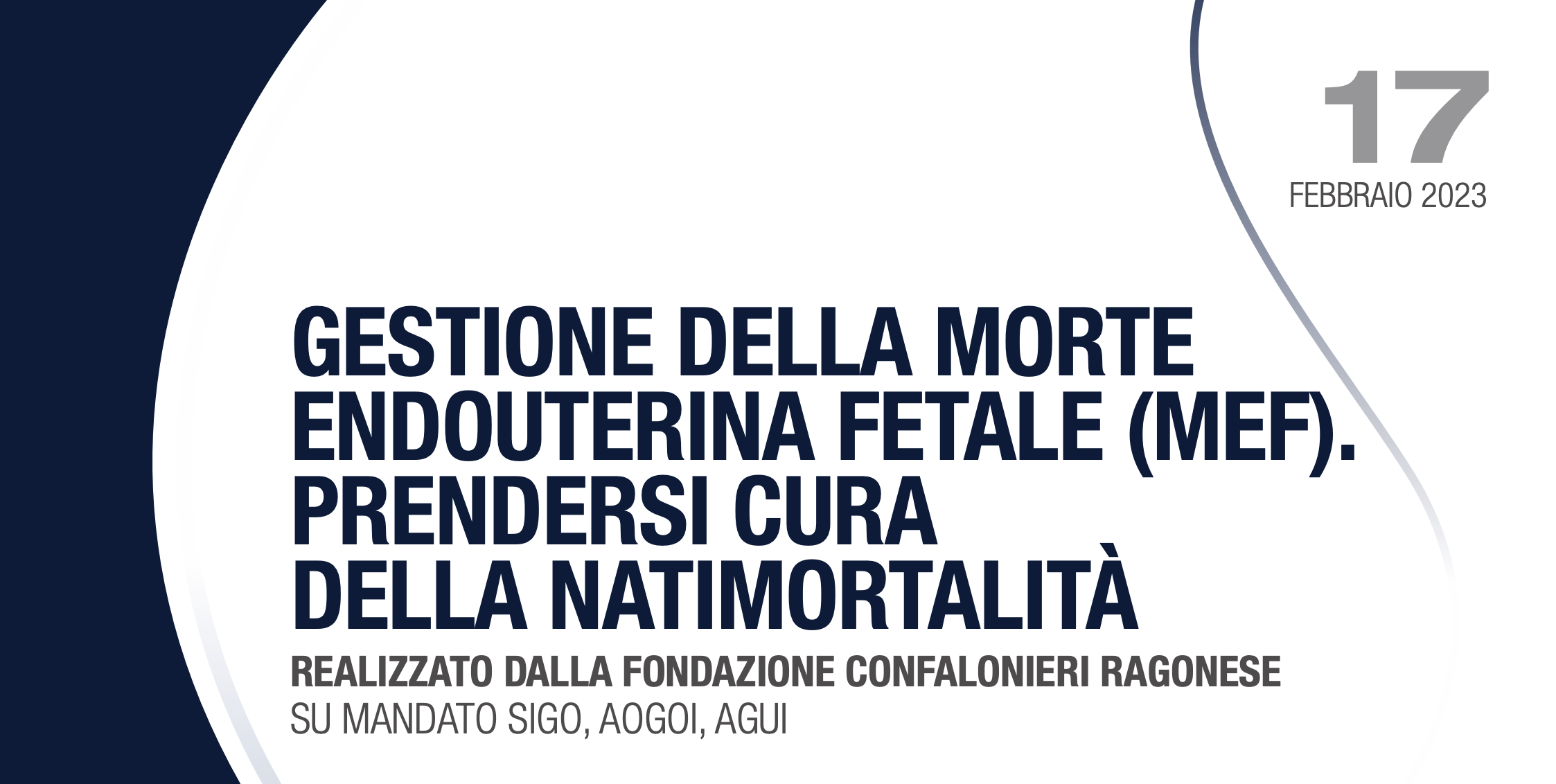
On February 7, 2023, the Recommendations on the Management of Fetal Endouterine Death (FEM) were published, a document that has been awaited for many years and is destined to become the Italian reference for professionals assisting women, couples and families affected by in utero death. The document, titled “Management of Endouterine Fetal Death (MEF). Taking care of stillbirth,” was drafted by the Confalonieri Ragonese Foundation on behalf of the three main scientific societies of Italian gynecology, SIGO, AOGOI and AGUI, and brings together in 132 pages the first organic body of national guidance on the topic, built on the adaptation of the main international guidelines (Queensland, PSANZ, SOGC, ACOG-SMFM) to the care, regulatory and cultural context of our country.
For our Foundation, this is particularly important news, not only because of the importance of the document itself, but because CiaoLapo took part in the drafting of the text: Prof. Alfredo Vannacci, vice president of the Foundation and head of the PeaRL Joint Perinatal Research Laboratory at the University of Florence, was among the document’s drafters, in a multidisciplinary working group of more than forty Italian professionals including gynecologists, obstetricians, neonatologists, anatomopathologists, epidemiologists and clinical psychologists.
Why these recommendations were necessary
Stillbirth is one of the most relevant health indicators of a population, and it is one of the most common adverse outcomes of pregnancy: it occurs in about 1 in every 200-300 deliveries in industrialized countries, with an Italian prevalence estimated at around 3-4 cases per 1000 births. It is an event whose frequency is often underestimated, but whose impact, emotionally and psychotraumatologically, is devastating for the couples and health care providers involved.
Despite the magnitude of the phenomenon, Italy has been in a paradoxical position to date: The Lancet ‘s latest series on stillbirth, Ending preventable stillbirths, conducted in 2016 with the participation of Claudia Ravaldi and Alfredo Vannacci of CiaoLapo, had in fact documented that our country was unable to provide information on causes of death in more than 50 percent of late stillbirths (after 28 weeks). The lack of uniform protocols for the evaluation and classification of stillbirths, coupled with the poor performance of key investigations (primarily autopsy and histological examination of the placenta), has long limited the possibility of understanding, and thus preventing, these events. The publication of shared National Recommendations is therefore, first and foremost, an act of responsibility to families and to the system of care.
The key points of the document
The Recommendations are divided into ten chapters covering the entire care pathway, from diagnosis to follow-up, and are accompanied by an operational summary summarizing their essential contents. We report here the passages that we consider most significant, with particular attention to aspects that intersect the work of our Foundation.
- Definition and registration. The document adopts the WHO international definition, considering as stillbirth any infant of gestational age ≥ 22 weeks diagnosed antepartum, or with Apgar 0 at first and 20th minute if dead intrapartum. All cases so defined must be recorded in the CedAP stream in order to build reliable national surveillance.
- Diagnosis and communication. The diagnosis of antepartum stillbirth requires urgent ultrasound evaluation performed by a specialist in gynecology and obstetrics, possibly in the presence of a supportive colleague. Communication of death is considered an integral part of the care process: it must be individualized, conducted in clear and understandable language, avoiding information overload and giving space for silence. Health care organizations are responsible for taking charge of training providers in communication, and cultural mediation must be provided for migrant women.
- Welcoming the woman and the couple. The communication of fetal death should take place in a confidential and quiet environment, with time for understanding, and in the presence, if the woman wishes, of a person of her choice. The woman should be accommodated in a preferably single room, not contiguous with the obstetrics or puerperium ward, and the possibility of psychological intake should be ensured with aproactive offer, also extended to the health care professionals involved.
- Childbirth care. The document recommends planning for vaginal delivery, reserving cesarean section for appropriate medical indications, and building a care pathway that includes dedicated midwife, place care (protected and isolated room, respect for intimacy) and pain support from the latent stage. Pharmacological analgesia should be provided with multimodal approach, while pharmacological sedation is not indicated. Particular attention is paid to theinhibition of breastfeeding or facilitation of milk donation, to be agreed promptly with the woman, and to the time of meeting with the baby, recognized as a fundamental moment in the grieving process.
- Diagnostic investigations. The document stresses the importance of routinely conducting the investigations necessary to understand causal factors, establishing a dedicated stillbirth medical record to be attached to the maternal record, and considering theautopsy as a key part of the diagnostic pathway: it is up to clinicians to make the parents understand its usefulness, and they can make use of a trusted consultant.
- Discharge, follow-up, and recurrence prevention. The discharge letter should include the case manager‘s reference, an appointment for continuity of psychological support, contacts of self-help groups in the area and online, and an appointment for the puerperium clinical visit. Memories of the baby collected during the hospitalization, including photographs, should be given to the parents or kept for their possible later request. Finally, subsequent pregnancy should be considered “at risk” and taken over by a specialist clinic or experienced professional.
- Clinical audit. A multiprofessional audit is recommended for each case of endouterine death within 90 days, aimed at defining the causes and associated factors, providing elements for communication with parents, estimating the risk of recurrence, and analyzing the care process.
A shared reference, and a starting point
The publication of the Recommendations represents, from our point of view, an important achievement for several reasons. The first is of a cultural nature: for the first time in Italy, the scientific societies of gynecology and obstetrics organically recognize that stillbirth is not only a clinical problem, but a bio-psycho-social event that requires, alongside technical expertise, attention to communication, relationships, places and times of care. The second is operational in nature: the document offers professionals a shared working tool that integrates international evidence with the specificity of the Italian context and with experience gained in the field, particularly through regional surveillance and the SPItOSS system of the Istituto Superiore di Sanità.
The third reason, for us, is more particular in nature. For many years, the Association and the CiaoLapo Foundation have been working, through research, training and family support, to build a model of perinatal death care that is salutogenic, trauma-oriented and centered on the needs of parents and caregivers. To find in the National Recommendations many of the principles that have long guided our work, and to have contributed to their drafting, is both a confirmation of the validity of the path we have taken and an incentive to continue it.
The “Assisting Perinatal Death” notebook.
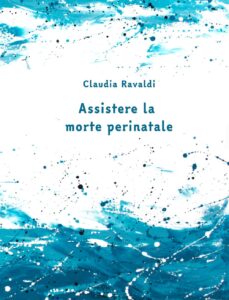 Near the release of the MEF Recommendations, the Foundation published the second expanded edition of “Assisting Perinatal Death – The Notebook,” by Claudia Ravaldi, published by CiaoLapo Editions. The workbook, designed as a working tool for professionals in the perinatal area, summarizes in ten chapters the care model developed by the Foundation: from diagnosis to communication, from bereavement to trauma, from hospitalization to respectful care, from bereavement care to meeting the child, and finally to memory collection and territorial follow-up. The preface, signed by Prof. Alfredo Vannacci, reminds us that training of professionals is associated with higher satisfaction of the bereaved, lower intensity of trauma-related symptoms, and lower levels of burnout among the professionals involved.
The two documents, the national text of the Recommendations and the CiaoLapo notebook, are designed to dialogue: the former as an institutional and clinical reference, the latter as an operational and training tool, built from listening to families and the experience of the departments that, for years, have been working alongside us in the Footprint registry.
Read more
- The full text of the Recommendations “Management of fetal endouterine death (EFM). Taking care of stillbirth” is available on the website of the Confalonieri Ragonese Foundation and the scientific societies SIGO, AOGOI and AGUI.
- Assisting Perinatal Death-The Notebook (2nd expanded edition, 2023), by Claudia Ravaldi, CiaoLapo Editions, ISBN 9788832242058, is available online and addressed to all perinatal health professionals.
- To learn more about CiaoLapo’s model of care, you can participate in the course “Memory Box, Trauma Oriented Hospital Care in Perinatal Bereavement,” offered free of charge to perinatal area ward workers.


